

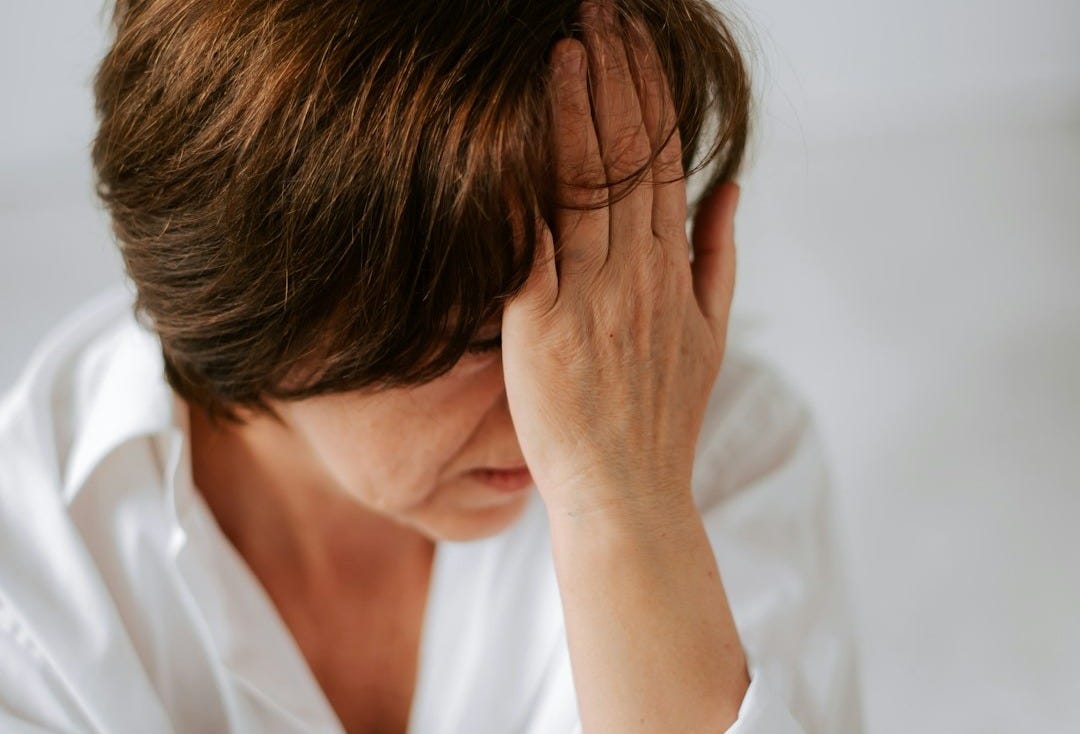
One of the more confusing (and frustrating) experiences of perimenopause is not knowing exactly why your feelings are changing toward your partner.
For example, you may know why you’re angry with them, but what you can’t understand is why you’re this angry. Something that once caused irritation may now leave you furious and swirl around in your head for the rest of the day.
It can be difficult enough dealing with a body that’s stopped feeling entirely familiar. So when changes extend to how you feel about your marriage, an added layer of confusion is introduced. You may find yourself less tolerant of your partner, more easily hurt by their behaviour, or increasingly resentful of things you’ve lived with for years.
Amid all the uncertainty about what’s happening to you, it’s natural to wonder what’s happening to your relationship. And while perimenopause may explain some of the relationship changes, it doesn’t necessarily explain everything that’s troubling you.
When your body changes how you feel
There’s a substantial physical reality to perimenopause that can be difficult to convey to someone who hasn’t experienced it. Hormonal fluctuations can affect emotional wellbeing, while disrupted sleep and other physical symptoms can make everyday life considerably more difficult to manage.
In research exploring women’s mental health during perimenopause and menopause, O’Reilly and colleagues (2024) found that some participants described feeling disconnected from a familiar sense of themselves. The women spoke about emotional changes that were distressing precisely because they felt so unlike their usual responses.
A 2022 study involving 73 women during the menopause transition also found associations between fluctuations in oestrogen and both mood-related symptoms and physiological responses to stress. Importantly, the research identified differences in how sensitive individual women were to hormonal changes (Lozza-Fiacco et al., 2022).
These findings help establish why perimenopausal emotional experiences deserve to be taken seriously as part of a significant biological transition. They also leave room for the considerable variation in how women experience it.
But a marriage has its own history, and hormonal changes take place within a relationship that may have developed its familiar difficulties long before perimenopause.
The things you’ve learned to live with
Every long-term relationship develops certain expectations about who does what and how each person responds to the other. Some are consciously negotiated, while others develop so gradually that neither partner gives much thought to how they came about.
You may, for example, have spent years being the dependable person in your relationship. The one who keeps life running smoothly and makes sure things get done. At times, you’ve probably resented how much responsibility falls to you. Although being relied on may also have given you a reassuring sense of your place in the relationship. Your partner, meanwhile, may have grown accustomed to depending on you. Living together in this way may just feel familiar, even if it hasn’t always been entirely satisfying.
Psychoanalytic thinking about couples recognises that partners can develop complementary roles which meet emotional needs neither has necessarily acknowledged. Norsa and Baldassarre (2007) describe how these ways of relating can provide a sense of security while making it difficult for either person to do anything differently. It suggests how we can become used to the person our partner needs us to be, sometimes without realising how much of ourselves we’ve invested in that identity. The capable partner may find reassurance in being needed, just as the person who relies on them finds comfort in their dependability. Both can become attached to a familiar way of living together, even when it causes frustration.
Of course, not every inequality in a relationship reflects this kind of unconscious process. Sometimes one partner has been asking for greater support for years, and the other has simply failed to respond. The history of those complaints shouldn’t disappear because the conflict has intensified now you’re managing perimenopause.
What makes this period potentially difficult for a couple is that one partner may no longer be able to sustain the role they’ve played for years. The demands of managing perimenopausal symptoms can leave less capacity for accommodating expectations that had previously felt manageable, while the frustrations associated with those expectations may have existed all along.
Your partner might experience your changing responses as unexpected or unreasonable. You may experience their continued expectations as increasingly intolerable. Neither of you may fully understand why something so familiar has become such a source of conflict.
When hormones become the explanation for everything
There can be some relief in attributing some of these changes to perimenopause. It helps explain the unfamiliar emotions you’re experiencing and offers hope that things may improve when your symptoms are better managed. For your partner, it may also provide reassurance that the relationship itself hasn’t fundamentally changed. The difficulties can be understood as something happening to you, with the expectation that you’ll eventually feel more like your old self.
But this explanation can become problematic if every disagreement is understood through the same lens. A complaint about feeling unsupported might be dismissed as irritability. Or a longstanding disappointment may receive less attention because your emotional response to it seems unusually intense.
In a qualitative study of 71 mainly British women, Hayfield and colleagues (2024) found that some participants attributed relationship difficulties to their own menopausal changes while excusing their male partners’ lack of understanding. The researchers observed how responsibility for relationship problems could be placed disproportionately upon the woman experiencing symptoms. That’s frustrating in itself!
Although this research largely reflects heterosexual relationships, the underlying difficulty is relevant to any relationship where someone is going through perimenopause. If one person’s hormonal changes account for everything that’s going wrong, there may be little reason to examine what their partner is contributing to the situation.
It’s also possible for the couple to get caught up in a frustrating cycle, where the more upset you feel, the more your partner attributes it to perimenopause. And the less seriously your concerns seem to be taken, the more frustrated you become. Before long, the argument becomes about how you’re reacting and the original grievance doesn’t get resolved.
What’s changing and what’s always been there?
It’s tempting to look for a definitive answer about what’s responsible for the difficulties you’re experiencing. But perimenopause introduces an uncertainty that isn’t always easy to resolve.
Some days your symptoms may feel manageable, while on others, they’re overwhelming. You may also go through periods of greater emotional stability followed by an unexpected return of anxiety or irritability. Your relationship can feel quite different depending on how you’re feeling physically and there may be no obvious pattern to explain it.
It can help to remain curious about these fluctuations. Does your frustration with your partner intensify when your sleep has been disrupted? Are there periods when your emotional responses seem unfamiliar even though nothing significant has happened between you? Do the same relationship concerns persist when your symptoms are less taxing?
These questions don’t provide a reliable test for separating hormonal effects from relationship difficulties. They’re ways of paying attention to experiences that may be influencing each other.
There’s also the relationship’s history to consider. The things you’re now finding intolerable may be difficulties you’ve raised repeatedly, or they may reflect genuinely new challenges. For example, changes in physical intimacy can be distressing even in a previously satisfying relationship. Where both partners are experiencing perimenopause, they may be confronting different physical and emotional changes at the same time.
It isn’t always possible to know how much of a difficulty belongs to the present and how much has been building over the years.
Talking with a therapist can offer room to explore the uncertainty, either individually or together. There may be longstanding patterns worth understanding, alongside changes in the relationship that require a different response from both partners. Support from a healthcare or wellbeing professional with expertise in menopause can also help you understand and manage the physical and psychological symptoms.
When going back to normal isn’t so simple
There’s an understandable wish for things to return to how they were. You want to feel more like yourself, and your partner may miss the familiar version of you they’ve lived with for years. But that previous version of your relationship may have depended on things that are now too difficult to sustain. Your partner may be hoping you’ll return to managing everything as before, while you’re increasingly aware of how much that has demanded of you. You might miss being the person who could cope with it all, even as you question why you were expected to.
This can be a difficult adjustment for both partners. Some of what you’re experiencing may ease with appropriate treatment and support. Other difficulties may require a reconsideration of how you live together. And there may be aspects of your relationship that you’ve been unhappy with for years, although the intensity of your current feelings has made them harder to overlook.
Perimenopause doesn’t necessarily offer a clearer view of your relationship, and there’s no reason to assume that every troubling feeling relates to an old grievance. It can make the familiar feel strange, while leaving you unsure how much of the change is temporary.
You may need time to understand what’s happening to your body and what your relationship needs in response. It’s possible to be struggling with perimenopause while also having legitimate concerns about your relationship. Both deserve attention, even when it’s difficult to know where one ends and the other begins.
If this reflects something you’ve experienced, I’d be interested to hear your thoughts in the comments. You can also subscribe to After the Honeymoon for more writing about the complexities of long-term relationships, or share this article with someone who might find it useful. Thanks for reading.
References
Hayfield, N., Moore, H., & Terry, G. (2024). “Friends? Supported. Partner? Not so much …”: Women’s experiences of friendships, family, and relationships during perimenopause and menopause. Feminism & Psychology, 34(3), 443–463.
Lozza-Fiacco, S., Gordon, J. L., Andersen, E. H., Kozik, R. G., Neely, O., Schiller, C., Munoz, M., Rubinow, D. R., & Girdler, S. S. (2022). Baseline anxiety-sensitivity to estradiol fluctuations predicts anxiety symptom response to transdermal estradiol treatment in perimenopausal women: A randomized clinical trial. Psychoneuroendocrinology, 143, Article 105851.
Norsa, D., & Baldassarre, L. (2007). Intimacy, collusion and complicity in psychoanalysis with couples. International Review of Couple and Family Psychoanalysis, 2007(2).
O’Reilly, K., McDermid, F., McInnes, S., & Peters, K. (2024). “I was just a shell”: Mental health concerns for women in perimenopause and menopause. International Journal of Mental Health Nursing, 33(3), 693–702.